
When reading the tagline for today’s recital – ballades, evocations, nocturnes, introspection, mazurkas, discoveries – did you stop to think about what you’re about to encounter, or did you really only register the familiar musical genres, glossing over the in-between “offbeats”? You’ll be perfectly excused if you saw ballades, nocturnes and mazurkas, thought “Yay, Chopin!”, and bought a ticket.
It’s those other words, though, that reveal everything about today’s repertory. Sure, we’ll hear beloved shorter pieces of solidly Romantic origin (Chopin), but also works that originally led to these very forms (Field), went on to inform the sound of early modernism (Szymanowski) and still inspire to this day (Adès). In a constant cycle of emotional trigger leading to creative thought leading to audible expression, ballades, nocturnes and mazurkas tell stories made deliberate and resonant by their companion nouns. The process that leads us from faint first awareness (evocation), to rationale (introspection), to breakthrough (discoveries) is not just how we actively listen to music – its also how humans, always, navigate life!
It’s human capacity for pinpointing a gap or lack, reflecting on it and then, through trial and error, deciding to address it that drives change, growth and hope for the future. By walking you through Inon’s brilliant and interweaved program while giving you contemporary examples of visible objects, I hope I can help you listen with greater appreciation and understanding, so that you can leave Lincoln Hall this evening brimming with plans and purpose!
FRÉDÉRIC CHOPIN
Ballade no. 1 in G Minor, op. 23
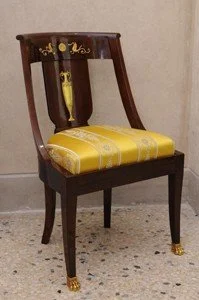
Chopin’s Ballade no. 1 in G Minor is to our ears what a 1830s French Restoration gondola chair is first to our eyes and second to our tired bodies: graceful, elegant and solid, “hugging” the human figure, creating a private sanctuary for comfortable lingering. The ballade opens with a dramatic half note on a low C, quickly followed by an upward sweep all the way to the highest parts of the keyboard. Once it reaches the crest, the musical line halts and descends in what mimics a human sigh – shifting the mood from a grand declaration to an expression of intimate melancholy. It’s as if someone threw open the doors of a room, saw a chair, sat down in it, and started spilling her deepest secrets.
Following the fall of Napoleon, furniture from the French Restoration period sought to distance itself from the imposing, militaristic Empire style. Design started focusing on comfort rather than pomp and formality. Similarly, Chopin’s first Ballade abandons the rigid, boxy edges of Classical sonata form in favor of continuous, sweeping narrative arcs. Beneath the highly polished veneer of both the gondola chair and the music, though, lies hidden structural tension: To get wood to bend to that iconically smooth and unbroken shape, it needs to be mechanically steam-bent, a process requiring extreme pressure and true craftsmanship. To “deform” the sonata and get it to become a highly personal, deeply emotive vehicle, Chopin does something very similar (don’t forget that when he started to compose this piece, in Vienna in 1831, he was an impoverished political refugee, wracked with survivor’s guilt.) He introduces clearly audible themes – but he doesn’t resolve them. Dissonant chords are suspended in mid-air. Pregnant silences abound. When the main G-minor waltz theme arrives, the familiar dance’s physics gets completely distorted by placing the deep bass note on the third beat rather than the first. When the explosive, fiery conclusion arrives, it feels like the snapping of the artificial curve of the chair – and from what we know of Chopin’s life, this “snap” was also psychological. The year he completed the ballade – 1835 – was also the year he had his first bout of coughing up blood. Do you hear the catastrophic panic?
JOHN FIELD
3 Nocturnes:
No. 2 in C Minor, H. 25
No. 12 in E Major, H. 13 (“Noontime”)
No. 13 in C Major, H. 45 (“Reverie”)
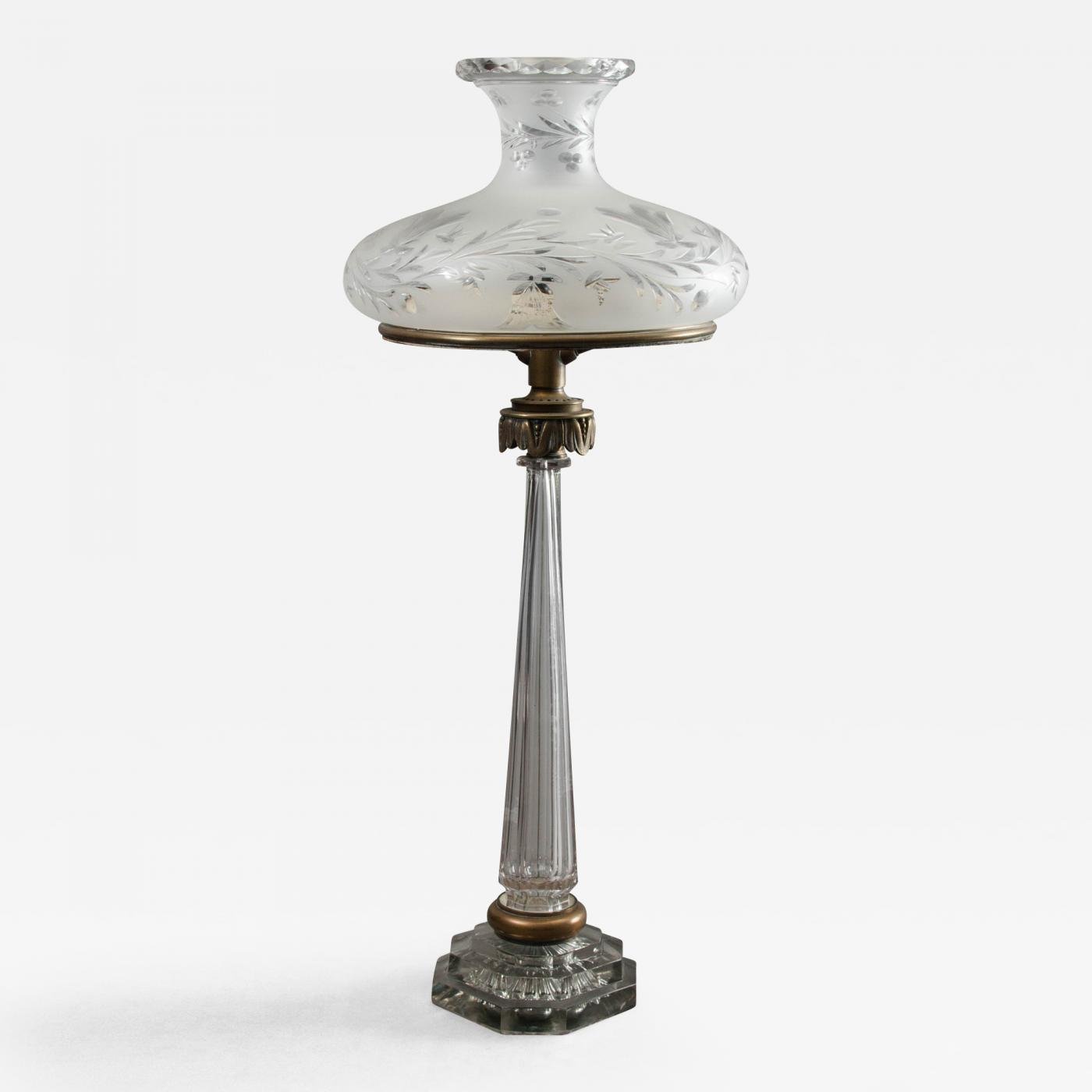
How does one cast a seamless, intimate glow over a room without the intrusion of harsh structural obstacles? Before the Sinumbra lamp (literally meaning “without shadow”) and the nocturne, artificial light and keyboard music were often matters of grand, public display, relying on massive, flickering chandeliers in ballrooms or virtuosic piano sonatas in public halls. The Sinumbra lamp was uniquely engineered as an elegant table piece to provide focused, soft illumination specifically for reading, sewing, or intimate conversation in 19th-century drawing rooms. Similarly, the Dublin-born John Field (who toured to Russia in 1802 with his teacher and mentor Muzio Clementi, then permanently settled in St. Petersburg) stripped away the shadow of theatrical display and turned the piano into an instrument for nocturnal, solitary confession. By using the new sustaining pedal to stretch out an open harmonic bass, he eliminated the rigid, “shadowy” middle-voice clutter of classical accompaniment, allowing a smooth, luminous ring of melody to hang elegantly in the air. Worth noting: When Field first started experimenting with these dreamy, non-sonata textures around 1811, he didn’t initially use the word “nocturne” – he thought of them as vocal songs transcribed for solo piano. What we now know as his Nocturne No. 1 in E-flat Major was initially published in Russia under the titles Romance or Pastorale! It was only by 1812 (when Nocturne no. 2 that we hear today was composed) that he settled on the term “nocturnes”, establishing a brand-new genre that freed composers of the rigid structure of the classical sonata.
The more than twenty-year chronological arc separating the early Nocturne No. 2 (1812) from the late Nocturnes 12 and 13 (1834) tracks Field’s evolution from establishing the blueprint of a simple, lyric vocal romance to expanding the form into an elastic canvas for experimental textures, domestic memories, and shifts of psychological light.

SAMUEL BARBER
Nocturne, op. 33 (“Homage to John Field”)
Remember the black rotary phone? The one that sat on its own, dedicated table or “gossip bench” in the hallway? Rolled out as the standard household phone in 1950, Henry Dreyfuss’s Model 500 phone didn’t invent the telephone; instead, it took an existing domestic utility and streamlined it – encasing it in a sleek, smooth thermoplastic shell with a perfectly balanced, lightweight handset and an utterly dependable internal mechanism.
Samuel Barber (born in 1910 in Pennsylvania) followed this same path when he composed his Nocturne in 1959. Standing against the mid-century tide of cold, hyper-intellectual avant-garde serialism, Barber championed a deeply expressive and resilient lyricism, using the comforting structures of the past to broadcast an anxious, modern psychological message. How does he strike a balance between old romance and new technology? By brilliantly deploying the classic, undulating arpeggio patterns invented by John Field and perfected by Chopin in the left hand – and treating the right hand as the avant garde explorer. While the melody is built from a twelve-tone row (pioneered by Arnold Schoenberg), it sounds beautifully atmospheric, hazy, and bluesy rather than jarringly mathematical. And the result is so tender and bittersweet that it sounds like a late-night phone call between long-distance friends, doesn’t it?

FRÉDÉRIC CHOPIN
Ballade no. 3 in A-flat Major, op. 47
Among Chopin’s four ballades, the third one stands apart as his most optimistic, sunlit and structurally harmonious. No dramatic opening gesture, no jarring dissonances, just a sweet and elegant melody in the upper register (marked dolce), starting a dialogue between the hands. This gives way to a rocking, dance-like second theme, underpinned by the gentle 6/8 lilt of a barcarolle (traditional Venetian boat song.) If the music makes you feel like sinking back in your chair and relaxing, you’re already anticipating the contemporary visual parallel: the French Voltaire armchair. Deliberately engineered to be the ultimate piece of bourgeois furniture, these gently reclining, plushily upholstered seats with their deep coil springs and broad, cushioned armrest were originally championed as a therapeutic seat for the sickly and fatigued but quickly became the pride of the 19th century middle-class parlor. Just as the Voltaire chair balanced high-society luxury with cozy everyday utility, Chopin’s Ballade no. 3 seamlessly blends sophisticated harmonic craft (a symmetrical melodic arch, clever enharmonic pivots delaying the gratification of finding the home key) with shimmering right-hand filigree and sweeping pedal textures – the piano version of luxurious velvet, rich brocade and meticulously carved wood. Both the chair and the ballade holds firm, thanks to its solid underlying framework: Even when it reaches the ultimate climax with massive chords and thunderous arpeggios, the conclusion is an unshakeable declaration of A-flat major stability.
Ballade no. 2 in F Major, op. 38
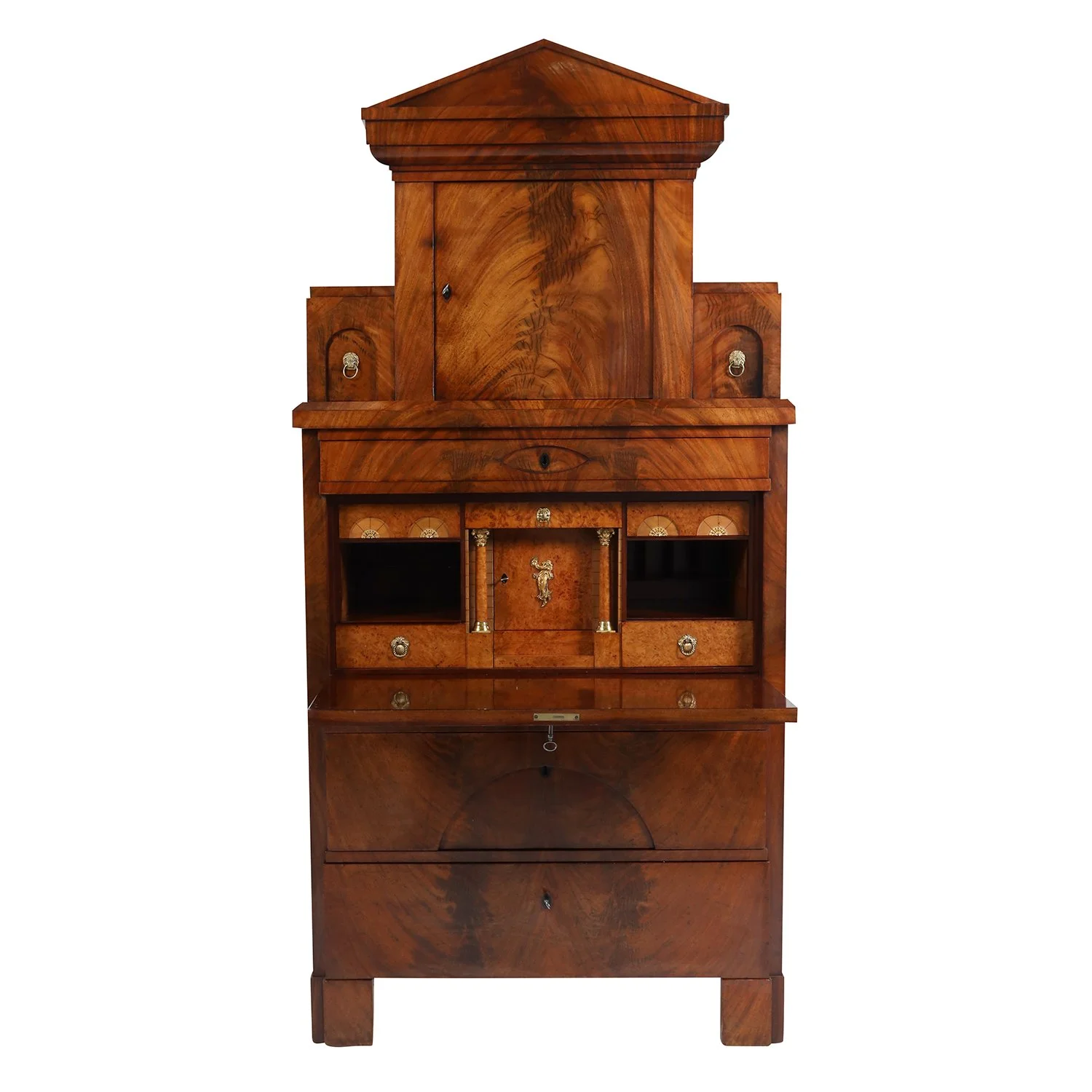
If “jarring structural dichotomy” feels like the best way to describe the intensity of of Ballade no. 2 in F Major, then the Biedermeier veneered mahogany cabinet secretary is the visual representation of this duality. Chopin composed and revised this Ballade between 1836 and 1839 (this timeframe includes his famously miserable winter in Mallorca), using elements of shock and concealment to expose an intricate inner world. He opens the piece with a placid, pastoral melody in F major that lures us into a peaceful lull, only to let the calm exterior drop away to reveal an explosive and thunderous minor section filled with polyrhythmic anxiety and rapid modulations. Just like the classic Biedermeier cabinet secretary that, when closed, presents a solid and unbroken domestic veneer, but once opened, reveals an astonishingly intricate inner world: tiny drawers, secret compartments, mirrored columns and hidden cavities.
Trapped by torrential downpours in a drafty monastery cell with George Sand, Chopin was forced to compress his grandest, darkest musical ideas into a solitary, localized form. The second ballade, in this sense, stands as a hyper-efficient container, condensing an epic narrative into a tightly-sealed single movement – just as the Biedermeier secretary packs a massive writing desk, a filing cabinet and a vault for valuables into the smallest possible physical footprint.

KAROL SZYMANOWSKI
3 Mazurkas, op. 50 nos. 1, 2 and 4
The partitioned, Russian-controlled Poland Chopin left behind in 1830 was a radically different cultural, political and psychological place from the one Karl Szymanowski inhabited. After gaining independence in 1918, Poland experienced a chaotic but euphoric wave of national rebirth, progressive modernization, and uninhibited confidence. Artists sought a modern, progressive artistic style that remained fiercely grounded in indigenous roots. This movement, championed beautifully by design collectives like ŁAD (pronounced “waht” and meaning “order”, “harmony” or “neatness”) excelled at weaving traditional, rustic folk crafts together with the striking, sharp geometry of international Art Deco.
Szymanowski, the foremost Polish composer of the 20th century, brilliantly bridged romanticism with progressive modernism, doing with sound exactly what what the textile artists of the Ład cooperative did with kilim rugs. Woven from coarse, hand-spun wool, the iconic kilims of the Ład cooperative showcase a bold, geometric modernism that relies on sharp, unblended color seams to stylize and elevate their rustic folk origins.
Composed between 1924–1925, the mazurkas from Szymanowski’s op. 50 similarly take raw, unpolished mountain folk music and bring harmonic order to it – using rigorous twentieth-century techniques such as bitonality and metric friction (meaning: rhythm that doesn’t follow a steady pulse.) From an authentic Tatra highland fiddle tune in Mazurka no.1, rhythmic play of pentatonic patterns in Mazurka no. 2, and angular syncopations and jagged accents in Mazurka no. 4, these dances (and Polish kilims!) stand as triumphant monuments to a hopeful (yet sadly short-lived) period in Polish history.
THOMAS ADÈS
3 Mazurkas, op. 27
But what, you may ask, is a “mazurka” anyway? After listening to Szymanokwski, you may already intuit that it’s a folk dance in 3/4 time, defined by its stomping quality: Unlike a smooth, gliding waltz, where the accent is always on the first beat (one two three, one two three), the mazurka shifts the accent to the second or third beat (one two three, one two three, or one two three, one two three).
One of the world’s most acclaimed contemporary composers, Thomas Adès was born and raised in London and was originally trained as a virtuoso pianist. Winning the second place in the 1989 BBC Young Musician of the Year competition pushed him to take composition more seriously. Throughout the 1990s and 2000s, Adès built a reputation for rewriting early music through a modern lens. With his 3 Mazurkas, op. 27, composed in 2009 to mark the celebration of the Chopin Bicentenary in 2010, Adès brings the historic Polish dance structure into the contemporary era.
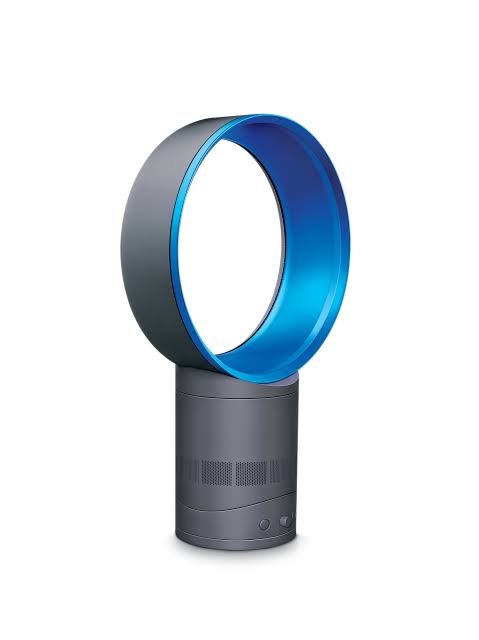
A nifty product from the same year, Dyson’s Air Multiplier bladeless fan, illustrates practically what Adès’s Mazurkas do conceptually. The bladeless fan performs a traditional function (moving air) but completely eliminates the visible, physical blades that historically did the work. Instead, air is forced through a hidden mechanism, leaving an eerie, empty architectural void in the center. Adès treats the Mazurka format identically. He strips the traditional 19th-century dance of its predictable physical mechanism (the stable 3/4 bar line and predictable downbeats), leaving behind an empty, ghostly acoustic ring where the effect of the dance is felt, but the physical structure has vanished.

FRÉDÉRIC CHOPIN
Ballade no. 4 in F Minor, op. 52
Playing Chopin’s fourth ballade as the finale of this program couldn’t be a more fitting choice: This jewel of a piece is widely considered the most sublime distillation of Chopin’s genius. Composed in his late maturity (between 1842 and 1843, partially in Paris and partially at Nohant with George Sand), the fourth Ballade successfully fuses two entirely different classical architectures: Sonata Form and Theme and Variations. Rather than choosing between a narrative journey or a repeating loop, Chopin layers them simultaneously.
It is in this ingenious method of layering where we find an unexpected household parallel: The early 1840s marked the exact moment the wallpaper industry shifted from slow, hand-stamped blocks to high-speed, mechanized cylindrical rollers. This groundbreaking industrial technology allowed multiple carved rollers, each inked with a different color, to print continuous rolls of paper in a single pass. However, because the technology was brand new, it required an astonishing level of human calculation to keep the moving parts aligned.
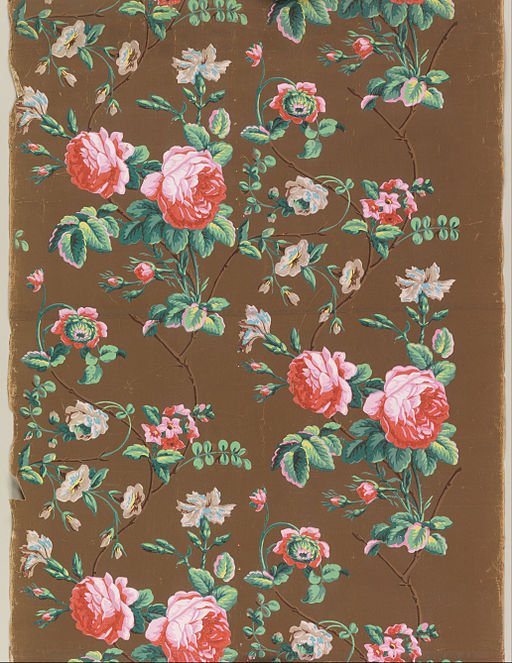
Chopin’s fourth Ballade reflects this exact industrial shift toward saturation. He moves away from the airy, single-line textures of his youth to weave a hyper-dense, complex matrix of independent voices and chromatic counterpoint directly onto the musical canvas.

Ultimately, much like a factory roller continuously stamping bold new colors over a delicate floral print, Chopin keeps spinning his main melody through heavier and more intricate layers of sound – until the whole musical machine tightly winds up and explodes into the wild, unraveled panic of the final pages. This is the music of a man who was suffering from chronic exhaustion, breathing difficulties and frightening hallucinations. Instead of staring at the wallpaper, though, he threw all 99 pounds of his body weight into creating this stunning music.